
The 2-Degree Deadline: Why 1.5°C is the Most Important Number in Your Life

Updated: Jun 29
Everyone is talking about climate change. Some call it the greatest threat to humanity; others The 2-Degree Deadline: Why 1.5°C is the Most Important Number in Your Lifecall it a hoax or an exaggeration.
For a moment, let’s park the debate.
Let’s forget about the politics, the protests, and even the "solutions" for a second. Before we decide what to do, we need to understand the phenomenon itself. This isn't about "saving the planet"—the planet will survive. This is about understanding the thermostat of the "House" we live in.
THE PLANET's BLANKET: The need for Green House gases
On a cold winter night, to stay warm, you pull over a blanket. That blanket doesn't create heat; it simply traps the heat your own body is generating.
The Earth does the same thing. The Earth radiates the Sun's energy back into space. Our "blanket" is a thin layer of gases in the atmosphere called Greenhouse Gases (GHGs).
Without GHGs, the Earth would be a frozen ball of ice at -18°C. GHGs enable a comfortable average of 15°C.
The problem isn't the blanket; it's that we are making the blanket thicker.

GHG Growth and the Human Impact
This Isn't a "New" Discovery
Climate change is not a "modern fad" created by 21st-century activists, the science is over a century old.
(In 1896, a Swedish scientist Svante Arrhenius was the first to calculate the impact of CO2 on the Earth’s temperature.)
The Rise
For nearly 1,000 years, the CO2 level was stable at approx 280 ppm (parts per million) - the "Ideal Level", that allowed human civilization, agriculture, and our modern world to flourish.
In just the last 150 years, we have reached over 420 ppm.

SO WHAT ?
Below is the rise in average Earth temperature.
Do you see a correlation with the CO2 graph?
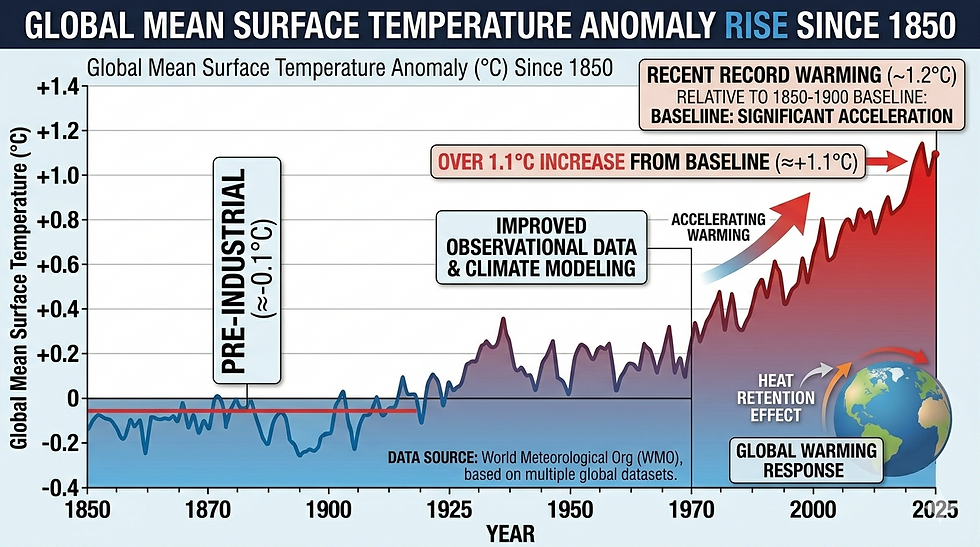
Natural processes have always affected Earth’s temperature & climate. But more recently, the change has been much faster
"IF THE WORLD IS WARMING, WHY WAS WINTER SO COLD IN SO MANY PLACES LAST YEAR?"
Here are a few points to note. We will cover these in detail
Weather is not climate!
What is Polar Amplification?
Climate change can produce both extreme heat and extreme cold—sometimes in places that rarely experience them.
Impact on the “House”: the 1.5 degree deadline
It’s not just about a warmer summer; it’s about a total shift in how the house functions. The "automated systems" have started failing.
Broken Weather Patterns: The House's AC and heater are fighting each other. Extreme heatwaves followed by freak storms.
Water Levels & Loss of Land: Melting ice in the "freezer" (the poles) leading to rising water levels. Several cities risk being reclaimed by the sea and rivers.
Droughts vs. Floods: Some rooms are bone-dry (droughts), killing crops, while others are drowning in water (floods) because the atmosphere is holding too much moisture (because of heat) and dumping it all at once.
Loss of Life Support: We are losing biodiversity and freshwater sources, making the house harder to live in for everyone.
We have already warmed the planet by about 1.1°C to 1.2°C above pre-industrial levels
Global Scientists have collectively agreed that warming beyond the 2 degree mark would have serious consequences for humans
Coming Soon Arrived in the “Theatre” around you
We don't need to look at polar bears to see climate change. We just need to look at the news cycles and events from the last 3–5 years.
The Disappearing Winter: Remember when winters in North India lasted three months or more? Now, it feels like we jump from "Light Sweater" to "High AC" in a matter of weeks. Snowfall amounts and durations in hill stations like Shimla, Manali or Gulmarg have shrunk due to what the scientists call “Snow Drought (click to read)”.
For all of us planning our vacations, it means a ruined holiday; for local families relying on tourism, it’s a livelihood crisis. And the most important impact is the water crisis that this could lead to. (Read Report)
The 50°C Summer & The Daily Struggle: It’s not just Delhi! Cities across Central, Western, and even Southern India are turning into concrete baking ovens. Think about how this alters a regular workday: soaring electricity bills, millions of outdoor workers including food and grocery delivery drivers navigating heat exhaustion, construction work halting completely in the afternoon, and apartment societies facing sudden water shortages because groundwater levels plunge. (Read Report)
Glacial Bursts & Mountain fragility: The Himalayas are changing faster than we can adapt. Sudden, catastrophic flash floods in several regions of Uttarakhand and Himachal are no longer "once-in-a-century" events. They are direct indicators that our high-altitude ice is unstable, threatening downhill pilgrimage routes, local infrastructure, and critical clean energy dams. (Report: Mountain regions show rapid environmental changes under human-driven warming.)
The Sinking and Storm-battered Coastline: Historically, the Bay of Bengal saw the bulk of violent storms while the Arabian Sea remained quiet. Now, human-induced warming has turned the Arabian Sea into a hot zone. Sea Surface Temperatures (SST) here have risen by 1.2°C to 1.4°C in recent decades. This warm water acts like high-octane rocket fuel for storms. (Research).
The Cyclone Chaos: We aren't just seeing more intense cyclones like Tauktae (2021) and Biparjoy (2023); we are seeing them intensify rapidly - sometimes jumping from a weak storm to a severe category cyclone in less than 24 hours.
Hijacking the Monsoon: This has a direct, chaotic impact on the Southwest Monsoon. When a massive cyclone develops in the Arabian Sea right around June, it acts like a giant atmospheric sponge. It sucks up all the moisture and kinetic energy from the ocean, concentrating it around the storm center and pulling it away from the mainland. This can completely stall the monsoon's advancement, leaving states like Maharashtra waiting anxiously for rain while a storm rages offshore. (Research)
Rising Seas: For a long time, "sea-level rise" felt like an issue only for tiny island nations. Today, it’s knocking on the doors of India’s coastal economic engines. According to a CSTEP report, continuing global emissions are driving ocean thermal expansion and melting glaciers at a rapid pace, with the IPCC projecting a global sea level rise of up to 1.6 meters by 2100.
Think about how this alters daily life in a coastal city: normal high tides now trigger severe waterlogging, crippling local train networks and trapping commutes in gridlock because city drainage systems fail completely. Beyond the flooded roads, rising seas push saltwater into underground aquifers, contaminating local drinking water taps and threatening vital coastal infrastructure, local tourism, and traditional fishing livelihoods.
Climate change is no longer a distant headline; it is a lived reality altering our daily commutes, our winter plans, and our household budgets.
No matter whether you live in the hills, the plains, or the coast, you have already started facing the heat - in the most literal sense.
The silver lining is that we aren’t watching this unfold alone. Most of the world today stands together in unified action toward climate change. From historic international policies and a massive surge in green technology investments to mainstream public awareness, the global community is actively transitioning from making simple pledges to enforcing real, structural solutions.
But on an individual level, cutting through the background chatter can be complicated. At un-noise, we find that most people fall into one of four distinct categories:
Bucket A: The Catalysts – You care deeply and are already part of the workforce or the solution, actively building or supporting sustainable alternatives.
Bucket B: The Overwhelmed – You care, but the sheer scale of the crisis feels paralyzing. You want to change things, but you don’t know where to start or how your daily choices can help.
Bucket C: The Procrastinators – You acknowledge that it’s a genuine problem, but your mindset remains: "It's fine for now; we’ll cross that bridge when we come to it."
Bucket D: The Skeptics – You believe it’s either a hoax or a natural planetary cycle that human choices cannot genuinely influence.

un-Noise FOOD FOR THOUGHT
Which bucket do you think you fall under?
Take a moment to step away from the global statistics and look at your immediate surroundings. Think of your own life as a small room. In this room, every convenience we use, every item we discard, and every choice we make creates a invisible thread that weaves into a massive global blanket—the very blanket trapping heat around our planet.
Where are you adding "extra threads" to the global blanket? More importantly, are any of those threads easily avoidable?
Comments